
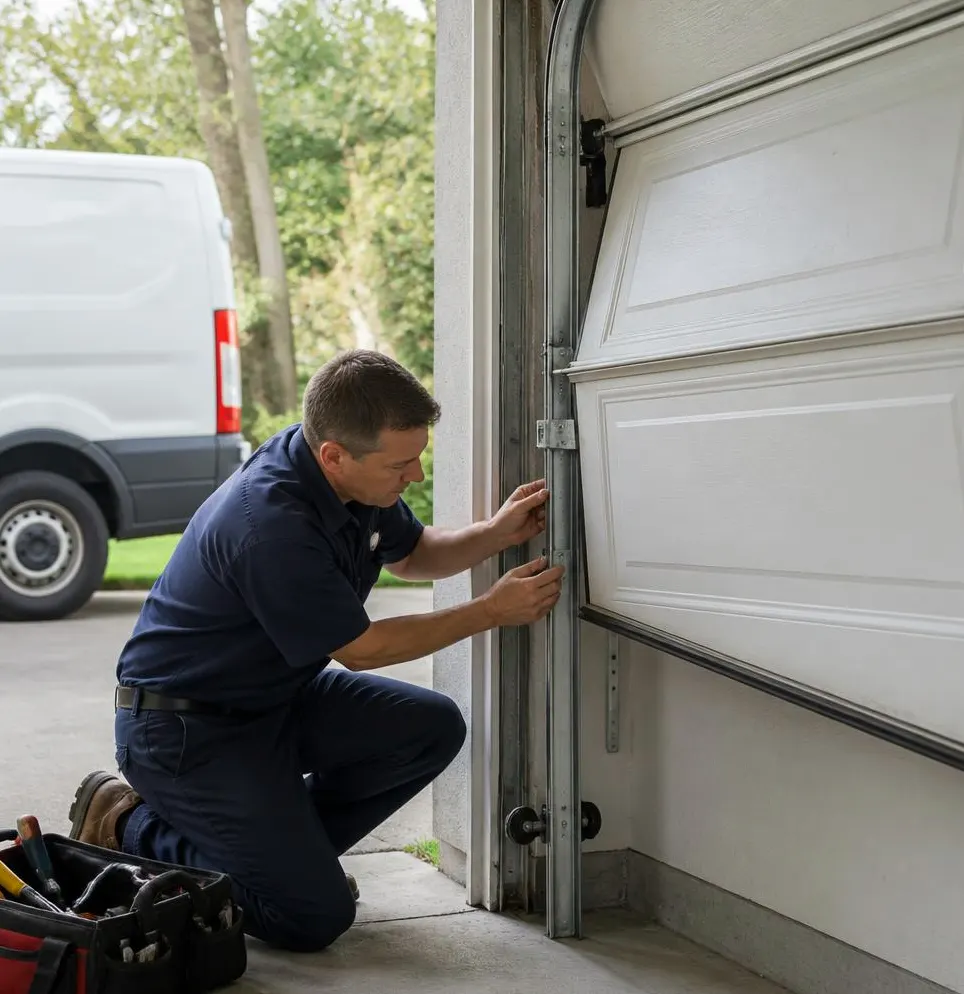
Short answer: it's not cosmetic, and you're right to be worried
If one of you noticed a frayed strand on the lift cable or heard a worn roller grinding in the track and said "we should deal with that," you were right. A frayed cable or a worn roller is not a cosmetic issue you can put off until it looks bad enough to bother you. It's a mechanical part under real load, and when it finally lets go, it doesn't give a polite warning first. It bangs, slams, or drops the door, usually at the worst possible moment. The person who wanted to wait and see wasn't wrong to want to save money — they just didn't know what "waiting" actually risks.
What these parts actually do
Your garage door doesn't lift itself. A torsion or extension spring stores the force, and a pair of steel cables transfers that force to the bottom corners of the door so it rises evenly. Rollers ride in the tracks on either side, guiding the door up and down without it binding or tilting. Every one of these parts is doing real work, every single cycle, whether the door is five years old or twenty-five.
Cables are made of thin steel strands wound together. Over thousands of open-and-close cycles, individual strands fatigue and snap, which is what you're seeing when a cable looks "fuzzy" or frayed near the bottom bracket or the drum at the top. Rollers — whether steel, nylon, or the sealed-bearing kind — wear down at the axle or the roller face itself, which shows up as flat spots, wobble, or that grinding, scraping sound as the door moves.
The symptoms worth paying attention to
- Visible fraying on either cable, especially near the bottom bracket or the drum
- A door that runs crooked or looks tilted to one side as it opens or closes
- Grinding, popping, or scraping coming from the tracks rather than the opener
- Jerky movement — the door hesitates, jumps, or seems to catch partway through the cycle
- A noticeably louder door than it was six months ago, even if nothing else has changed
Any one of these on its own is worth a look. Several at once, especially fraying plus noisy rollers, means the system is further along than it appears.
Why Southern Maryland weather speeds this up
Humid summers aren't just uncomfortable for people — they're hard on steel cables and bearings. Moisture in the air gets into the cable strands and the roller axles, washes out lubrication faster than you'd expect, and invites surface rust that weakens steel from the inside out, often before it's visible from the outside.
Winter does the opposite kind of damage. Icy mornings mean metal contracts, grease stiffens, and a roller that was already slightly worn suddenly has more resistance to fight through. That's often when a marginal cable, already thinned by rust, takes on extra strain and finally frays through or snaps.
Heavy rain and the occasional coastal storm add a third factor: water intrusion around tracks and bottom brackets, especially on older housing stock where weatherstripping and track alignment haven't been touched in years. Newer homes aren't immune either — nylon rollers still wear, and a door that's been fine for a few years can start showing the same fraying and grinding once it hits a certain cycle count.
The part that should end the argument
Here's the mechanism that makes this dangerous rather than just annoying: the spring holds enormous stored tension, and the cables are what keep that tension under control as the door moves. A cable that's frayed enough to snap doesn't just stop working quietly — it releases that tension all at once. The result can be a door that drops hard, slams down, or jumps off the track entirely, sometimes with enough force to damage the door panel, the frame, or anything underneath it. A worn roller that finally fails can cause the same kind of sudden jolt, especially on an older torsion system where the parts were never designed to be mismatched with newer hardware. The "loud failure" one of you is worried about isn't an exaggeration — it's exactly what happens when these quiet parts give out.
What's safe to do yourself, and what isn't
You can safely look for fraying and listen for grinding. You can lubricate rollers and hinges with a garage-door-specific lubricant (not WD-40, which washes out rather than staying put). What you shouldn't do is touch the cables, the springs, or try to adjust the tension system yourself. Torsion springs in particular store enough force to cause serious injury if handled without the right tools and experience, and a cable under load isn't something to improvise a fix for with a trip to the hardware store.
When to call Mechanicsville Garage Door
If you've spotted frayed strands, heard grinding rollers, or noticed your door running crooked, it's time to get it looked at before it fails on its own schedule instead of yours. We handle spring replacement and full garage door maintenance for homes across Mechanicsville, Charlotte Hall, Leonardtown, Hollywood, Hughesville, La Plata, Waldorf, and California, and we'll tell you honestly whether you need a cable swap, new rollers, or a full tune-up to catch the smaller issues before they turn into a dropped door.
If something sounds or looks off, don't wait for the loud version of this problem. Call Mechanicsville Garage Door and let's get it sorted before winter ice makes it worse.